
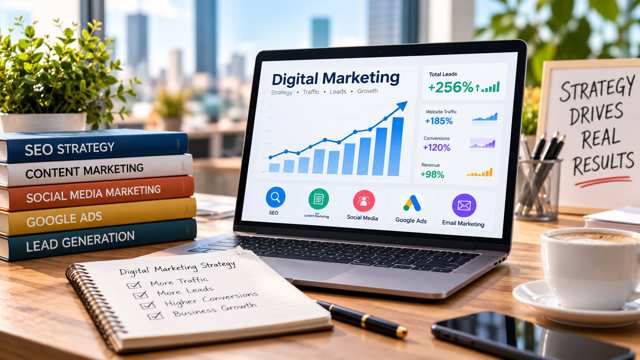
More traffic doesn’t automatically mean more sales. A strong digital marketing strategy for small businesses attracts people who need your services and helps them take the next step. That means aligning search intent, SEO, paid ads, useful content, and conversion-focused website pages.
In this guide, learn how to generate more qualified leads online, which commercial-intent keywords to target, and how to measure the results that matter.
What Is Digital Marketing Lead Generation?
Digital marketing lead generation is the process of reaching potential customers through channels such as search engines, paid advertisements, email, and social media, then encouraging an action like a phone call, quote request, or consultation booking. The goal is not simply to collect contacts: it is to attract prospects who are a realistic fit for your services.
1. Target High-Intent Digital Marketing Keywords
People search differently depending on whether they are learning, comparing solutions, or ready to hire. Commercial and transactional queries are especially useful for service and landing pages.
Commercial-intent keyword ideas
- digital marketing agency for small business
- digital marketing services for local businesses
- SEO services for small business
- local SEO agency
- Google Ads management services
- PPC management agency
- lead generation services for small business
- social media marketing agency
- conversion rate optimization services
- website design and SEO services
These are relevant keyword candidates, not verified rankings by search volume or conversion rate. Validate demand, competition, and geographic fit with Google Keyword Planner, Search Console, and your actual customer inquiries. Build separate pages for distinct services rather than stuffing every keyword onto one page.
2. Make SEO Work for Real Buyers
Good search engine optimization services start with useful, original content and a website that visitors can navigate easily. Each core service page should explain who the service is for, the problems it solves, what working together looks like, and how to request help.
Use descriptive page titles, clear headings, internal links, accessible images, mobile-friendly layouts, and accurate business details. For local businesses, keep your Google Business Profile complete and current. See our related guide: How to Improve Your Google Business Profile to Get More Local Customers.
3. Combine SEO With Google Ads for Faster Testing
SEO can build long-term visibility while Google Ads management gives businesses a way to test targeted offers and search queries. Organize campaigns around specific services, use relevant negative keywords, and send clicks to landing pages that closely match each ad.
A search for “local SEO services” should lead to a focused local SEO page—not a generic homepage. Measure qualified inquiries and customers acquired, not just ad clicks.
4. Create Landing Pages Designed to Convert
A conversion-focused landing page usually needs a specific headline, a clear service promise, helpful proof, an easy-to-use form, and one primary call to action. Explain what happens after someone submits a request, and avoid asking for more information than you need.
Strong call-to-action examples include Request a Personalized Quote, Book a Digital Marketing Consultation, and Discuss Your Lead Generation Goals. Use only promises and testimonials that your business can substantiate.
If your current site struggles to convert visitors, read How Do I Know If My Business Website Needs a Redesign?.
5. Use Social Media to Build Trust and Follow Up
Social media marketing for business growth works best when posts answer customer questions, demonstrate expertise, explain services, and drive visitors to a relevant next step. Mix educational posts with case studies, practical tips, and authentic behind-the-scenes content.
A social post may not create a sale immediately. Track whether it brings useful site visits, consultations, return visitors, or assisted conversions. Explore our social media lead generation strategy guide for more ideas.
6. Track Cost Per Qualified Lead, Not Vanity Metrics
To understand digital marketing ROI, connect your analytics, form submissions, phone calls, and CRM when possible. Review these measures consistently:
- Conversion rate: the share of visitors who complete a desired action.
- Cost per lead: marketing spend divided by leads generated.
- Cost per qualified lead: spend divided by leads that meet your criteria.
- Lead-to-customer rate: the percentage of leads that become customers.
- Customer acquisition cost: the cost of acquiring a new customer.
Compare channels using consistent definitions and meaningful time periods. Performance varies by industry, competition, sales cycle, and offer.
7. Build a Practical 30-Day Digital Marketing Action Plan
- Week 1: Audit your website, existing traffic, lead forms, and most important services. Choose one measurable lead-generation goal.
- Week 2: Research buyer-intent keywords and improve one priority service page and its call to action.
- Week 3: Publish supporting educational content and test one tightly targeted campaign if your budget allows.
- Week 4: Review qualified inquiries, user behavior, and landing-page conversion rates. Improve the weakest part of the journey.
Frequently Asked Questions
What digital marketing strategy is best for small businesses?
The best mix depends on what you sell and how customers buy. Local SEO and a strong Google Business Profile can help service-area businesses; search ads may help capture immediate intent; content and social media can support trust and longer buying cycles. Start with one or two channels you can measure.
How do I get more qualified leads from my website?
Target specific buyer questions, explain your services clearly, make your site easy to use on mobile, use relevant landing pages, and offer a straightforward consultation or quote request. Follow up promptly and track lead quality.
How long does digital marketing take to produce results?
Paid campaigns may begin collecting data quickly, while SEO and content efforts usually require continued work and evaluation. Neither channel guarantees a specific timeline or number of leads.
Should I hire a digital marketing agency?
Consider an agency when you need specialized skills, consistent execution, or clearer reporting. Ask about the proposed strategy, measurement, communication, and how success will be defined for your business.
Ready to Turn Digital Marketing Into More Business Opportunities?
A practical marketing plan should connect visibility with leads and customer acquisition. Kristyl Media can help you discuss your goals and identify opportunities for your website and digital presence. Visit Kristyl Media to get in touch and start a conversation about your digital marketing priorities.