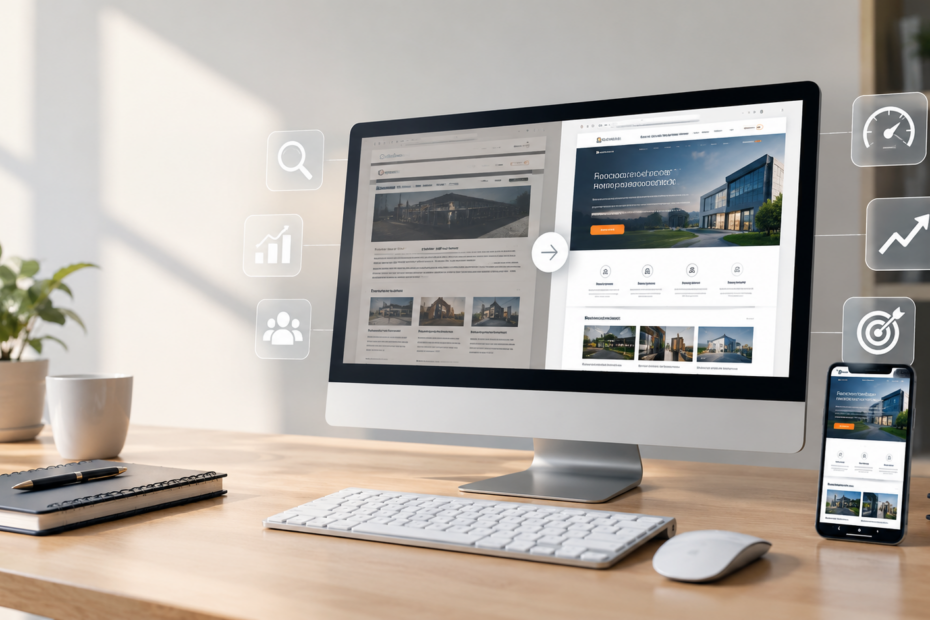
Your business website is often the first place potential customers go to learn about your company. If the site looks outdated, loads slowly, is difficult to use on a phone, or makes it hard for visitors to take the next step, you could be losing customers before they ever contact you.
So, how do you know when it is time for a website redesign?
A business website likely needs a redesign if it is outdated, difficult to navigate, slow, not mobile-friendly, hard to find in search, or failing to turn visitors into leads. A redesign is not simply about making a website look better. The goal is to create a faster, clearer, search-friendly website that supports your business goals and makes it easier for the right customers to take action.
In this guide, we will cover the most common signs that your website needs attention and what a modern business website should do instead.
What Is a Website Redesign?
A website redesign is the process of improving an existing website’s appearance, structure, functionality, content, performance, and user experience.
A redesign can range from updating specific pages and fixing technical problems to rebuilding an entire website from the ground up.
A strong redesign should consider:
- Website structure and navigation
- Mobile responsiveness
- Page speed and technical performance
- Search engine optimization
- Content quality
- Calls to action
- Lead generation
- User experience
- Conversion opportunities
- AI and answer-based search visibility
The goal is not simply to create a prettier website. It is to create a website that works harder for the business.
How Do I Know If My Business Website Needs a Redesign?
There are several warning signs that your current website may be holding your business back.
1. Your Website Looks Outdated
Your website does not need to follow every design trend, but it should look professional and reflect the quality of your business.
An outdated website can create questions in a potential customer’s mind:
- Is this business still operating?
- Can I trust this company?
- Will they provide a professional experience?
- Is this information still accurate?
If your website looks like it was built many years ago and has not been meaningfully updated, a redesign may be worth considering.
2. Your Website Is Difficult to Use on a Phone
Mobile usability is no longer optional.
Many potential customers will discover your business from a smartphone. If they have to zoom in, scroll sideways, fight with menus, or struggle to complete a form, they may simply leave.
Quick answer: Your website should provide a clear and easy experience across smartphones, tablets, laptops, and desktop computers.
A responsive website automatically adjusts its layout to different screen sizes, helping visitors navigate and interact with your business regardless of the device they use.
3. Your Website Loads Slowly
People expect websites to load quickly.
Large images, outdated technology, unnecessary scripts, poor hosting configurations, and other technical issues can slow down a website.
A slow site can hurt more than the user experience. It can also make it harder for your website to perform effectively in search.
A website audit can help identify issues such as:
- Slow-loading pages
- Large image files
- Broken links
- Technical errors
- Poor page structure
- Unnecessary scripts
- Other performance problems
Before rebuilding an entire website, it is often useful to determine exactly what is causing the problem.
4. Visitors Cannot Quickly Understand What You Do
Imagine someone visits your homepage for the first time.
Can they understand within a few seconds:
What do you offer? Who do you help? Why should they choose you? What should they do next?
If the answer is unclear, your website may need better messaging and structure.
A modern website should make the visitor’s next step obvious.
That could mean:
- Requesting a quote
- Booking a consultation
- Calling the business
- Buying a product
- Filling out a form
- Learning about a service
The easier you make the decision, the easier you make it for visitors to become leads or customers.
Can an Old Website Still Rank on Google?
Yes. An older website can still rank in search results.
However, the age of a website itself is not the main issue. The bigger questions are whether the site is technically healthy, useful to visitors, relevant to search intent, properly optimized, and regularly maintained.
A website can look modern but still have serious SEO problems. Likewise, an older-looking website may continue generating traffic if its content and technical foundation are strong.
That is why a website redesign should not begin with design alone.
Does a Website Redesign Help SEO?
A website redesign can improve SEO when it addresses technical problems, site structure, content, mobile usability, page performance, and search intent.
However, redesigning a website does not automatically increase rankings.
A poorly planned redesign can actually create SEO problems if important pages, URLs, content, internal links, or metadata are removed without a proper migration strategy.
A search-focused redesign should consider:
- Page titles and meta descriptions
- Heading structure
- Internal linking
- Keyword and topic targeting
- Search intent
- Website architecture
- Page speed
- Mobile usability
- Image optimization
- Redirects
- Indexing
- Local search visibility
The redesign should improve both the human experience and the search engine’s ability to understand the website.
What About AEO and GEO?
Search is changing.
People are increasingly asking questions directly through AI-powered search experiences, voice assistants, and AI-generated search results.
That means businesses should think beyond traditional search engine optimization.
SEO helps your website become more visible in traditional search results. AEO focuses on making information easy for search engines and AI systems to understand and use as direct answers. GEO focuses on improving the likelihood that your business is recognized, referenced, and recommended within generative search experiences.
A modern website should therefore provide clear, useful information that answers the questions potential customers are actually asking.
For example, instead of having a service page that only says:
“Professional Marketing Services”
A stronger page could clearly explain:
- What the service includes
- Who it is for
- What problems it solves
- How the process works
- What customers can expect
- Frequently asked questions
- What makes the company different
- How to get started
This gives both people and search systems more useful information to work with.
What Should a Modern Business Website Include?
A strong business website should make it easy for visitors to understand the company, find information, and take action.
Depending on the business, important elements may include:
| Website Element | Why It Matters |
|---|---|
| Clear homepage messaging | Helps visitors understand the business quickly |
| Mobile-friendly design | Makes the site easier to use on phones |
| Fast page performance | Improves usability and supports search performance |
| Strong calls to action | Guides visitors toward the next step |
| Service pages | Explains what the business offers |
| Useful content | Answers customer questions |
| SEO structure | Helps search engines understand the site |
| AEO-friendly content | Makes answers easier to extract and understand |
| Local information | Supports local discovery |
| Contact options | Makes it easier to become a lead |
| Analytics and tracking | Helps measure website performance |
The exact structure should depend on the business, its customers, and its goals.
Should You Redesign Your Website or Fix the Existing One?
Not every website needs to be completely rebuilt.
Sometimes the better solution is to repair and optimize the existing website.
A website audit can help determine whether the problems are related to:
- Technical issues
- Poor page speed
- Broken links
- Weak content
- Poor navigation
- Outdated design
- Weak conversion paths
- SEO problems
- Mobile usability
- A combination of several issues
For example, a business may have a strong website foundation but a few outdated pages and technical problems. In that situation, targeted improvements could make more sense than starting over.
On the other hand, if the website has an outdated structure, poor user experience, weak content, technical problems, and limited scalability, a complete rebuild may provide a better long-term foundation.
What Happens During a Professional Website Redesign?
A strategic website redesign typically starts with an evaluation rather than immediately changing the design.
The process can include:
Step 1: Website Audit
Identify technical errors, performance problems, SEO issues, broken links, and opportunities for improvement.
Step 2: Business and Customer Analysis
Understand what the business offers, who it serves, what customers are looking for, and what actions the website needs visitors to take.
Step 3: Website Structure
Organize pages and navigation so users and search systems can easily understand the website.
Step 4: Content Strategy
Improve or create content around the topics, services, questions, and search intent that matter to the business.
Step 5: Design and Development
Build or update the website with responsive design, clear messaging, useful functionality, and strong conversion paths.
Step 6: SEO, AEO, and GEO Optimization
Optimize the website so it can support traditional search visibility as well as modern answer-based and generative search experiences.
Step 7: Testing and Launch
Test the website across devices, review links and forms, check performance, and make sure important pages are properly configured before launch.
Step 8: Ongoing Optimization
A website should not be considered finished the day it launches. Performance, content, search visibility, and conversion data should continue to be reviewed and improved.
How Often Should a Business Redesign Its Website?
There is no universal rule that says a website must be redesigned every specific number of years.
A better approach is to evaluate the website based on performance and business needs.
Consider a redesign when:
- The website no longer represents the business
- Customers struggle to navigate it
- It performs poorly on mobile devices
- The site is consistently slow
- Leads are declining
- Important information is difficult to find
- The website is difficult to update
- The design looks significantly outdated
- SEO performance has major technical limitations
- The business has grown beyond the website’s current structure
The right time for a redesign is when the website is no longer effectively supporting the business.
Final Takeaways
Your website should do more than exist online.
It should help people discover your business, understand your services, trust your company, and take the next step.
If your website is outdated, slow, difficult to navigate, poorly optimized, or failing to generate opportunities, it may be time to take a closer look.
The key points are:
- A website redesign is about more than visual appearance.
- Mobile usability and page speed matter.
- Clear messaging helps visitors understand your business.
- SEO should be considered before and during a redesign.
- AEO and GEO are increasingly important as search evolves.
- Some websites need a complete rebuild while others need targeted improvements.
- A website should continue to be optimized after launch.
Is Your Website Helping Your Business Grow?
Kristyl Media helps businesses build, improve, and optimize websites that are designed to support real business growth. From website design and rebuilds to SEO, AEO, GEO, content, social media, digital marketing, and lead generation, our team can help bring the different pieces of your marketing strategy together.
If you are not sure whether your website needs a few improvements or a complete redesign, start with a website audit and identify what is actually holding your site back.